
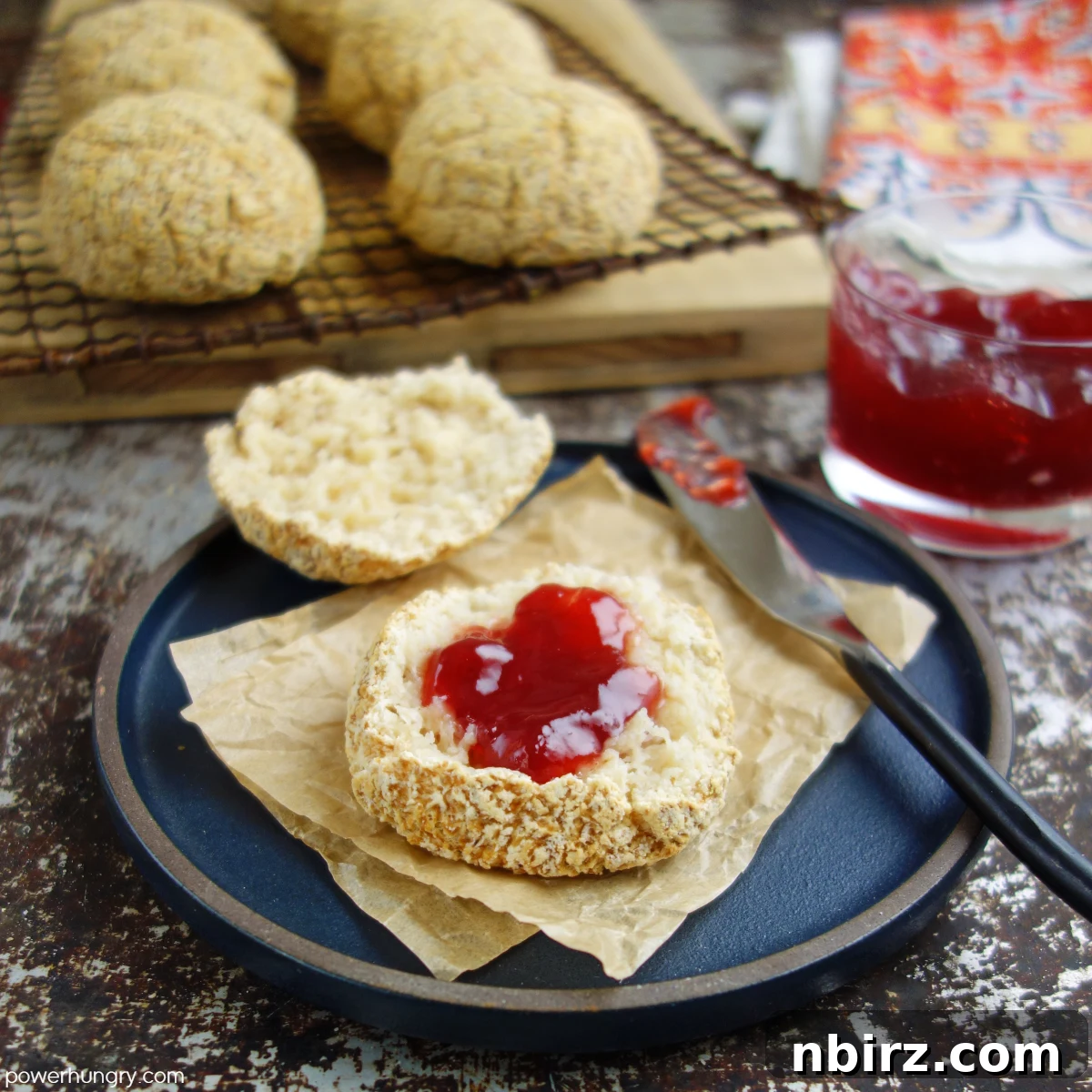
My truly effortless, 100% coconut flour bread rolls are (without exaggeration) a 4-ingredient marvel. Achieving a soft and wonderfully fluffy texture, these rolls are not only incredibly easy to prepare but also cater to a wide range of dietary needs. They are vegan, ketogenic, oil-free, grain-free, nut-free, yeast-free, and sugar-free, all while being remarkably low in calories at just 63 per roll.
Revolutionary Vegan Keto Bread: Crafted Exclusively with Coconut Flour
Imagine the excitement of discovering a bread recipe that defies expectations. That’s precisely the feeling these remarkable bread rolls evoke! I can hardly contain my enthusiasm, and once you try them, you’ll understand why. They are truly exceptional, embodying everything you could wish for in a homemade bread:
- Unbelievably Soft: A tender crumb that melts in your mouth.
- Delightfully Fluffy: Light and airy, far from dense or heavy.
- Authentically Bread-y: Possessing the satisfying texture and taste of traditional bread.
- Effortlessly Simple: Designed for quick and easy preparation, even for novice bakers.
- Pure Coconut Flour: Made with 100% coconut flour, eliminating the need for any other flours or starches.
While any soft, fluffy, and easy-to-make bread is cause for celebration, an egg-free recipe that relies entirely on coconut flour—without a trace of nut flours, seed flours, grains, or starches—is a true culinary breakthrough. This unique combination makes these rolls an absolute revelation, especially for those navigating specific dietary restrictions. Get ready to jump out of your chair and into the kitchen as you uncover the secrets to these truly swoon-worthy bread rolls.
Unmatched Benefits of These Coconut Flour Rolls
Warm, tender, incredibly filling, and versatile enough to pair with any meal or topping, these quick and easy rolls are designed to be loved by everyone. If you’re still wondering if these rolls are as miraculous as they sound, consider the extensive list of benefits they offer. They are crafted with health and dietary considerations at their core, making them an ideal choice for a diverse audience:
- Just 4 Core Ingredients: Minimal ingredients (plus water & optional salt) simplify your baking process.
- Completely Vegan: Free from eggs and dairy, perfect for plant-based diets.
- Keto-Friendly: An excellent choice for low-carbohydrate lifestyles.
- Paleo Approved: Aligns with a paleo dietary approach.
- Oil-Free: Baked without any added oils for a lighter option.
- Yeast-Free: No waiting for dough to rise, making them quick to prepare.
- Sugar-Free: Contains no added sugars, relying on natural flavors.
- Grain-Free: Ideal for those avoiding grains.
- Gluten-Free: Naturally free of gluten, suitable for individuals with gluten sensitivities or celiac disease.
- Nut-Free: A safe option for those with nut allergies.
- Xanthan Gum-Free: Achieves perfect texture without this common thickener.
- High in Fiber: Each roll boasts 6 grams of fiber, supporting digestive health.
- Low in Calories: A mere 63 calories per roll, fitting easily into calorie-controlled diets.
- Low-Carb: With only 2.8 grams of net carbs per roll, they support ketosis and stable blood sugar levels.
This impressive list of attributes truly highlights the exceptional nature of these humble bread rolls. Despite their numerous health advantages, their simplicity in terms of both ingredients and preparation remains paramount. Continue reading to discover exactly what you’ll need and how effortlessly you can bake a batch of these delightful rolls.
Essential 4 Ingredients for These Miraculous Rolls
The beautiful, golden-brown rolls you see pictured above are truly created with nothing more than these four fundamental ingredients, complemented by a bit of tap water. Each ingredient plays a crucial role in achieving the rolls’ incredible texture and flavor, especially important when working with unique flours like coconut flour.
- Coconut Flour: The star of the show. Coconut flour is highly absorbent and unique, making it a powerful ingredient for gluten-free baking. It imparts a subtle sweetness and a wonderfully soft crumb when used correctly.
- Whole Psyllium Husks: This is a game-changer for structure and texture in gluten-free, yeast-free baking. Psyllium husks, when mixed with liquid, form a gel that mimics gluten, providing elasticity and binding properties essential for light, fluffy bread. (Note: Using whole husks is critical for this recipe; psyllium powder behaves differently).
- Baking Soda: Our primary leavening agent. When combined with an acid, baking soda creates carbon dioxide bubbles, giving the rolls their rise and airy texture.
- Cider Vinegar: The acid component that reacts with baking soda, activating its leavening power. It’s essential for achieving the light and fluffy structure without yeast.
While these four are the non-negotiables, I personally love to add a small amount of fine sea salt to enhance the overall flavor. However, salt is entirely optional and can be adjusted to your preference, as it is not vital for the bread’s structure. You can also get creative with additional flavorings later on (I’ll share some ideas towards the end of this article). But for your very first batch, I strongly recommend keeping them plain to truly appreciate their exquisite simplest form.
Effortless Step-by-Step Instructions
Unlike traditional yeast-risen bread rolls, which demand considerable time and specific baking skills, these coconut flour rolls are refreshingly straightforward. They require neither extensive kneading nor lengthy proofing, making them perfect for busy schedules or those new to baking. Just follow these simple steps to create your own batch of delicious, healthy rolls.
Step One: Prepare the Psyllium Gel Base
In a medium-sized mixing bowl, combine the measured water, cider vinegar, and whole psyllium husks. Whisk these ingredients together thoroughly until they are well blended. Now, allow this mixture to rest undisturbed for approximately 5 minutes. During this crucial waiting period, the psyllium husks will absorb the liquid and transform into a loose, pale, and homogenous gel. This gel-like consistency is vital for providing the necessary structure to our gluten-free dough. Ensure you give it the full 5 minutes to properly set up.
Step Two: Combine the Dry Ingredients
While your psyllium mixture is gelling, turn your attention to the dry components. In a separate, smaller mixing bowl, whisk together the coconut flour, baking soda, and the optional (but recommended) fine sea salt. Continue whisking until these dry ingredients are thoroughly blended, ensuring an even distribution of the leavening agent. Proper mixing at this stage is important for uniform rise and flavor in your finished rolls.
Step Three: Form the Dough
Once your psyllium gel has properly thickened, add the whisked coconut flour mixture directly into it. Using a sturdy spoon or spatula, stir vigorously until all the dry ingredients are completely incorporated into the gel, forming a cohesive dough. This dough will be notably firm, yet still moist to the touch. It’s crucial to ensure there are no dry pockets of flour remaining to achieve the best texture for your rolls.
Step Four: Shape and Prepare for Baking
Carefully divide the firm dough into 6 equal portions. For precise and uniform rolls, I highly recommend using a digital kitchen scale; each portion should weigh approximately 62 grams. Take each portion and gently squeeze, then roll it between your palms to form a smooth, round ball. Arrange these dough balls on a baking sheet that has been lined with parchment paper, ensuring they are spaced at least 2 inches apart to allow for proper air circulation and expansion during baking. This careful spacing will prevent them from sticking together and ensure an even bake.
Bake to Golden Perfection!
With your oven preheated to 350°F (180°C), carefully place the baking sheet with the shaped rolls inside. Bake for a full 60 minutes. During this time, watch as the rolls puff up beautifully, developing a gorgeous golden-brown crust. They should feel dry to the touch, indicating they are thoroughly cooked. This hour-long bake ensures a perfectly cooked interior and a satisfying outer texture. Do not be tempted to shorten the baking time, as coconut flour needs adequate time to fully cook through and eliminate any raw flour taste.
Once baked, gently transfer the rolls from the baking sheet to a wire cooling rack. It’s absolutely essential to allow them to cool completely before attempting to eat them. Cooling allows the internal structure of the bread to set properly, preventing a gummy texture and ensuring the desired soft and fluffy crumb. Patience is key here – resisting the urge to cut into them prematurely will be rewarded with the perfect bread experience. You’ll be amazed at how good these rolls look!
Taste and Texture Profile: Truly Authentic Bread
I know I might sound repetitive, but the outstanding texture of these rolls truly warrants the emphasis: they are incredibly soft and fluffy. This is not a mere imitation bread; it is genuine, satisfying bread in every sense of the word. Many gluten-free and alternative bread recipes often result in dense or crumbly textures, but this recipe manages to achieve a delicate and airy crumb that rivals traditional wheat-based rolls.
The flavor profile of the bread is elegantly neutral, offering a clean canvas for various toppings and accompaniments. You’ll notice only the faintest hint of natural sweetness, which comes inherently from the coconut flour itself. This subtle sweetness is not overpowering, allowing the bread to be equally delicious whether paired with savory dishes or sweet spreads. Its versatility is one of its greatest strengths, making it a perfect staple for any meal.
Versatility in Shaping: Beyond the Standard Roll
While this particular recipe yields exceptional bread rolls, it is important to note that the specific ratios and properties of coconut flour and psyllium husks mean it does not scale well to larger formats. Therefore, attempting to bake this dough as a full loaf will not yield the same successful results. The delicate structure is optimized for individual rolls.
However, these rolls are wonderfully adaptable for creating smaller, snack-sized bread bites! This miniature version is absolutely delightful and perfect for appetizers, children’s portions, or simply enjoying a smaller treat. To make these adorable mini rolls, simply divide the dough into 12 equal pieces instead of 6. Each portion will be approximately the size of a golf ball. Roll them into smooth balls as you would the larger rolls, and then bake them for a slightly reduced time of 50 minutes (instead of 60 minutes). This adjustment ensures they bake through without drying out, maintaining their soft interior.
Troubleshooting Common Baking Issues
Even with simple recipes, minor issues can sometimes arise. If your coconut flour rolls don’t turn out quite as expected, it’s most likely due to one of the following common reasons. Addressing these points will help ensure your next batch is a resounding success:
- Inaccurate Measurement: Precision is paramount in baking, especially with highly absorbent flours like coconut flour and gelling agents like psyllium husks.
- Solution 1 (Best Practice): The most reliable way to ensure accuracy is to weigh your ingredients using a digital kitchen scale. This eliminates inconsistencies that come with volume measurements.
- Solution 2 (If using cups/spoons): If you are relying on dry measuring cups and spoons, it’s critically important to measure coconut flour and psyllium husk correctly. Lightly spoon the ingredient into the measuring cup/spoon and then level it off with a straight edge (like a knife). Do not pack the flour or scoop directly from the bag, as this can lead to too much flour.
- Solution 3 (Liquid Measurement): Always measure water and other liquids using a clear, liquid measuring cup, which has markings designed for accurate fluid volumes, rather than a dry measuring cup.
- Dark Baking Sheet: The color of your baking sheet significantly impacts how your baked goods cook.
- Solution: As a general rule, always opt for a light-colored, metal baking sheet. Dark-colored baking sheets absorb and conduct heat more intensely, which can lead to overbrowning, or even burning, the bottoms of your rolls before the interior is fully cooked. Parchment paper helps, but a lighter sheet is best.
- Baking Soda Issues: The leavening agent is crucial for the rolls’ rise and fluffiness.
- Solution 1 (Baking Soda vs. Powder): Ensure you are using baking soda, not baking powder. They are not interchangeable in this recipe due to different chemical reactions.
- Solution 2 (Acid Reactant): Confirm that vinegar (or lemon/lime juice) is included in the recipe. This acidic component is absolutely critical for activating the baking soda and enabling the rolls to rise properly. Without it, your rolls will be dense.
- Solution 3 (Freshness): Baking soda can lose its potency over time. If your baking soda has been in the pantry for several years, it may have lost its leavening power. It’s a good idea to refresh your stock with a new box periodically to ensure optimal results.
Frequently Asked Questions About Coconut Flour Bread Rolls
Can I Substitute Coconut Flour with Another Flour?
For this specific recipe, no, other flours cannot be substituted for coconut flour. Coconut flour is exceptionally unique due to its incredibly high absorbency rate and fibrous composition. The liquid-to-flour ratio required for coconut flour is dramatically different from almost any other flour, including almond flour, oat flour, or traditional wheat flours. Attempting to substitute will lead to a completely different, and likely unsuccessful, result. While I may develop other single-flour roll recipes in the future, the ingredient proportions will be vastly different to accommodate the characteristics of those particular flours.
Can I Use a Substitute for Whole Psyllium Husks?
Important Update (November 10, 2021): I strongly advise against using psyllium powder in place of whole psyllium husks for this recipe. While it might theoretically seem like a viable substitute, I have not personally tested the recipe with psyllium powder. More importantly, several readers have reported significant problems and inconsistent results when attempting this substitution. Whole psyllium husks provide a specific gelling and binding property that is crucial for the structure and texture of these rolls. For the best and most reliable results, please stick to using whole psyllium husks.
Furthermore, other common gelling agents, such as ground flaxseed meal or chia seeds, will not function effectively as substitutes for psyllium in this recipe. Their chemical and physical properties are too different to replicate the desired outcome.
Are There Alternatives to Cider Vinegar?
Absolutely! If you don’t have cider vinegar on hand, or simply prefer another option, an equal amount of fresh lemon juice or lime juice can be used as a direct substitute. Both provide the necessary acidity to activate the baking soda and achieve the desired rise. Additionally, feel free to use any other variety of vinegar you might have in your pantry, such as white vinegar or even balsamic vinegar, without significantly altering the flavor profile or effectiveness in this recipe.
Can I Add Extra Flavors to the Rolls?
Yes, absolutely! The neutral base of these rolls makes them an excellent canvas for various flavor additions. You can easily incorporate dry spices such as cumin, turmeric, chili powder, or smoked paprika for a savory kick. Dried herbs like Italian herb blend, basil, rosemary, or oregano will lend an aromatic quality. For a more intense savory flavor, consider adding garlic powder, onion powder, or a dash of black pepper. Finely chopped fresh herbs, such as chives or parsley, can also be folded into the dough. Any of these flavor enhancements should be added during Step 3, when you combine the wet and dry ingredients, to ensure even distribution throughout the dough.
Happy baking, and enjoy your delicious, homemade coconut flour bread rolls!
Explore More Coconut Flour Bread Recipes You’ll Love:
- Keto Vegan Coconut Flour Bread {Oil-Free, Grain-Free}
- 4-Ingredient Coconut Flour Bread {Vegan, Keto, Oil-Free}
- Coconut Flour Cauliflower Bread {Vegan, Keto}
- 2-Ingredient Coconut Flour Tortillas {Vegan, Keto, Oil-Free}
- 3-Ingredient Sweet Potato Tortillas {Grain-Free, Vegan}
Average rating: 4.93 stars from 84 votes
Pin Recipe
Print Recipe
100% Coconut Flour Bread Rolls {Vegan, Keto, 4 Ingredients}
By: Camilla
My 100% coconut flour bread rolls are (all humility aside) 4-ingredient miracles. Soft and fluffy, they are vegan, keto, oil-free, grain-free, nut-free, yeast-free, sugar-free & only 63 calories apiece.
Prep Time: 8 minutes
Cook Time: 1 hour
Total Time: 1 hour 8 minutes
Servings: 6 rolls (can be adjusted)
Ingredients
- 1 and 1/4 cups (310 mL) water
- 1 and 1/2 teaspoons cider vinegar
- 2 and 1/2 tablespoons (13 g) whole psyllium husks (do not use powder)
- 2/3 cup (75 g) coconut flour
- 1/2 teaspoon baking soda
- 1/4 teaspoon fine sea salt (optional/adjustable)
Instructions
- Preheat oven to 350F (180C). Line a large, light-colored baking sheet with parchment paper.
- In a medium bowl, whisk the water, vinegar, and psyllium husks until blended. Let stand for 5 minutes to thicken.
- In a small bowl, whisk the coconut flour, baking soda, and (optional/adjustable) salt until blended. Add this mixture to the psyllium gel and stir until completely combined into a stiff but moist dough.
- Divide the dough into 6 equal portions (each roughly 62 grams). Squeeze and roll each portion into a smooth ball. Space the dough balls at least 2 inches apart on the prepared baking sheet.
- Bake in the preheated oven for 60 minutes until the surface of the rolls is golden brown and appears dry.
- Transfer the rolls to a cooling rack. Cool completely before serving.
Notes
Storage: Store the cooled rolls in an airtight container at cool room temperature for 2 days, in the refrigerator for 1 week, or in the freezer for up to 6 months.
Make Smaller Bread Rolls: For mini rolls, divide the dough into 12 equal pieces (each about 31 grams) and roll into balls. Bake as directed but for only 50 minutes.
Net Carbohydrates: Each roll contains approximately 2.8 grams of net carbohydrates.
Vinegar Options: An equal amount of any other vinegar (e.g., white vinegar) or fresh lemon or lime juice can be used in place of cider vinegar.
Psyllium Tip: For best results, use whole psyllium husks. Psyllium powder behaves differently, and several readers have reported issues when substituting it.
Flavor Add-Ins: During step 3, feel free to add dry spices (like cumin, turmeric, chili powder, smoked paprika), dried herbs (such as Italian herbs, basil, rosemary, oregano), garlic powder, onion powder, black pepper, or finely chopped fresh herbs.
Nutrition Facts (per roll)
Serving: 1 roll | Calories: 63kcal | Carbohydrates: 8.8g | Protein: 1.8g | Fat: 1.3g | Saturated Fat: 0.4g | Sodium: 230.6mg | Fiber: 6g | Sugar: 0.9g
Love this recipe? Please consider rating and leaving a comment below! Your feedback helps other bakers discover and enjoy these wonderful rolls.